Why Authority Ecosystems Are Replacing Traditional Content Marketing in 2026
A Framework for Building Trust, Visibility, and Long-Term Business Growth
For years, digital marketing strategies focused heavily on content production, social media consistency, and audience engagement metrics.
However, the online marketplace has shifted significantly in 2026.
Artificial intelligence now allows businesses and individuals to rapidly produce articles, videos, graphics, and marketing campaigns at scale. As digital content volume continues increasing across nearly every platform, consumers are becoming more selective regarding which brands and professionals receive attention and trust.
According to Rene’ Manfre, Founder of WYP Media
www.wypusa.com in New Orleans, Louisiana, the primary challenge facing many businesses today is no longer content creation alone.
“The larger challenge involves establishing credibility, visibility, and long-term authority within increasingly competitive industries,” says Manfre.
Industry professionals are beginning to recognize the rise of what many describe as “authority ecosystems” — integrated systems of educational content, media visibility, strategic partnerships, community engagement, and trust-based branding.
The Shift Toward Trust-Based Digital Marketing
Consumer decision-making behavior has evolved considerably over recent years.
Before purchasing products or services, many consumers now evaluate:
- online reputation,
- educational content,
- search engine visibility,
- leadership credibility,
- customer reviews,
- podcast interviews,
- media exposure,
- and overall digital presence.
In many industries, visibility and credibility now carry as much weight as the actual products or services being offered.
Businesses consistently providing educational value and market insight are increasingly separating themselves from competitors relying solely on traditional advertising.
Why Traditional Marketing Strategies Are Becoming Less Effective
Many businesses continue relying heavily on:
- paid advertising,
- cold outreach,
- disconnected social media activity,
- and short-term promotional campaigns.
Although these methods may still generate temporary results, they often fail to establish long-term trust and market positioning.
Modern audiences increasingly respond to:
- educational content,
- transparent communication,
- authentic leadership,
- community involvement,
- and demonstrated expertise.
As digital competition continues growing, businesses that establish recognizable authority are gaining stronger long-term advantages.
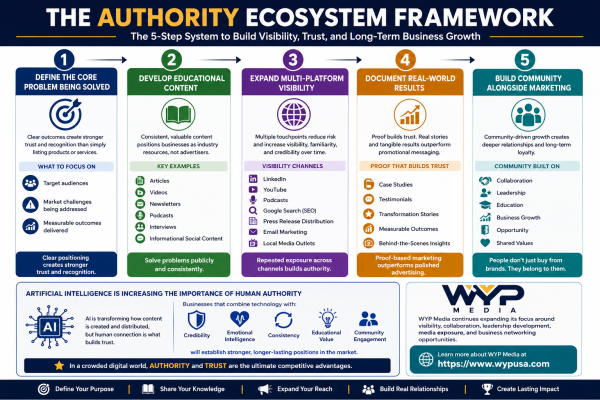
The Authority Ecosystem Framework
The following five-part framework is increasingly being used by businesses and entrepreneurs seeking stronger visibility and credibility in modern digital markets.
1. Define the Core Problem Being Solved
Businesses communicating clear outcomes generally perform more effectively than businesses focusing only on products or services.
Consumers respond more positively to organizations that clearly explain:
- target audiences,
- market challenges being addressed,
- and measurable outcomes being delivered.
Clear positioning creates stronger trust and recognition.
2. Develop Educational Content
Educational content remains one of the most effective long-term trust-building strategies available.
Businesses consistently publishing valuable insights and practical information position themselves as industry resources rather than advertisers.
Examples include:
- articles,
- videos,
- newsletters,
- podcasts,
- interviews,
- and informational social media content.
The objective involves solving problems publicly and consistently.
3. Expand Multi-Platform Visibility
Businesses relying on a single digital platform face increasing risks associated with changing algorithms and shifting audience behavior.
High-growth organizations are expanding visibility across:
- LinkedIn,
- YouTube,
- podcasts,
- Google search,
- press release distribution,
- email marketing,
- and local media outlets.
Repeated exposure across multiple channels reinforces familiarity and credibility over time.
4. Document Real-World Results
Consumers increasingly place greater trust in documented proof than promotional messaging.
Case studies, testimonials, transformation stories, measurable outcomes, and behind-the-scenes business insights help strengthen authenticity and credibility.
Proof-based marketing strategies are becoming more influential than heavily polished advertising campaigns.
5. Build Community Alongside Marketing
Community-driven growth has emerged as one of the strongest trends in modern business development.
Audiences increasingly seek connection with organizations representing:
- collaboration,
- leadership,
- education,
- business growth,
- opportunity,
- and shared values.
WYP Media continues expanding its focus around visibility, collaboration, leadership development, media exposure, and business networking opportunities.
Additional information regarding WYP Media is available at:
https://www.wypusa.com
Artificial Intelligence Is Increasing the Importance of Human Authority
Although artificial intelligence continues transforming marketing and content production, many industry observers believe AI is simultaneously increasing the value of authentic human communication and leadership.
As AI-generated content becomes increasingly common, businesses combining technology with:
- credibility,
- emotional intelligence,
- consistency,
- educational value,
- and community engagement
are expected to establish stronger long-term market positions.
In an increasingly crowded digital environment, authority and trust are rapidly becoming some of the most valuable assets businesses can build in 2026 and beyond.
Rene' Manfre / WYP Media